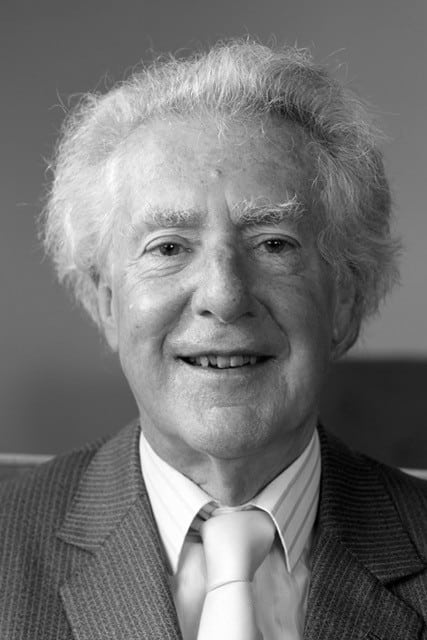
Dr Anthony ‘Tony’ B Hunt (1944-2025)
BLitt MA Oxf, DLitt St And, FBA, FSA
It is with great sadness that the Master and Fellows of St Peter’s College Oxford share news of the death of our Emeritus Fellow, Dr Anthony ‘Tony’ Hunt, on Monday 3 November 2025. Our thoughts are with Tony’s wife, Kate, and their families, friends and loved ones.
Tony was born on the Wirral in 1944. In 1962, he matriculated at Worcester College, University of Oxford, where he read for a BA in Modern Languages. He stayed on at Oxford to complete a BLitt before obtaining a post at the University of St Andrews teaching Anglo-Norman. He later became Reader in French at St Andrews, where he was in due course awarded a DLitt for research conducted whilst a British Academy Research Reader and Visiting Professor of Medieval Studies at Westfield College in London. In 1990, Tony returned to Oxford to take up a Faculty Lectureship and Tutorial Fellowship at St Peter’s College.
Tony made a substantial contribution to medieval French and Anglo-Norman scholarship, publishing 24 volumes and 150 articles containing previously unpublished medieval texts. He was Honorary Treasurer and, later, President, of the Anglo-Norman Text Society. He was recognised with multiple honours for his academic reputation and expertise in the use of French in medieval England, medieval medicine and editing Old French texts. He became a Fellow of the Society of Antiquaries in 1986 and in 1999 was elected both a Foreign Member of the Norwegian Academy of Science and Letters and a Fellow of the British Academy. In 2008, he was appointed Officier dans l’Ordre des Palmes Académiques by the French Government.
In addition to his notable teaching and research impact at St Peter’s College, Tony served for a period as Vice-Master of the College. He demonstrated care for the entire College, showing equal concern and interest in the College’s place in the Norrington Table, staff wellbeing and the overall state of the College’s buildings and offices. He retired from his University post in 2009 but continued in his Tutorial Fellowship until 2011, after which he was elected Emeritus Fellow of St Peter’s College. For several more years after his retirement, Tony could be seen in the Hall for breakfast and lunch on most weekdays, as he continued to spend his mornings at the Taylorian pursuing his life’s work of study and scholarship.
A memorial to honour Tony’s life and contribution to St Peter’s will take place in College on Saturday 16 May 2026. Learn more here.
Memories of Tony
From colleagues and friends
'I first met Tony in 1992, for a French Paper VI tutorial (on Chrestien de Troyes) which took place in the office in Canal House that I myself would end up occupying two decades later. This meeting had been preceded by a panicked phone call (internal line; no email back then) in which I desperately sought advice about how to read Old French and prepare for the tutorial; his sage counsel, delivered with his characteristic wit and charm, forms the basis of my own teaching to the present day. It was likewise Tony who shared with me the secret formula for getting a First in Finals; who shaped my inchoate DPhil into a meaningful project; who guided me into my first academic post; who suggested (eventually) that I might find Anglo-Norman interesting; and who supported my subsequent professional and personal endeavours every step of the way. Scholars all around the world know Tony's academic work; I was blessed to know him as a mentor, colleague, and friend. I shall never forget him.' - Prof Daron Burrows, Fellow and Tutor in Medieval French at St Peter's College
'I first met Tony when I came to Oxford to be interviewed for the post I currently hold. He welcomed me to St Peter's with open arms and a twinkle in his eye. I remember many entertaining conversations over lunch, about knotty translation problems and students' ingenious solutions. I can't go into the Taylorian Reading Room and pass the desk by the door where he always sat without picturing him there, and smiling at the memory. I vividly recall his valedictory dinner, and his speech, which ended with a quote from Dylan Thomas: "Rage, rage, against the dying of the light". This was Tony's polite but angry way of protesting against the threats to the Humanities, Modern Languages in particular, which he could already see on the horizon. I will always be grateful to Tony for teaching me how to be a Fellow.' - Prof Claire Williams, Fellow and Tutor in Portuguese at St Peter's College
'Some decades ago I tried to persuade Tony that it was possible to now get decent coffee in Oxford but it meant going across the High. "Out of the question", said Tony, "From the station I go to St Peter’s and then to the Taylorian". What folly (on my part) to think for a moment of disturbing this routine, or, as I came to think of it, this "liturgy of scholarship".' - Henrietta Leyser, Emeritus Fellow
'I have elsewhere written at length about Tony, so will limit myself here to commenting that whilst committed to the highest academic standards, he didn't give a fig for the Norrington Tables as a serious measure of them.' - Eric Southworth, Emeritus Fellow, St Peter's College
'Tony was one of the most impressive individuals I met at Oxford University. His wisdom, wit and kindness were exceptional and his scholarship in his beloved subject was and will remain definitive. He was hugely productive and superbly educated academic star but rarely stressed and never driven by any careerist aspirations. In the best possible way, Tony was a holistic man of letters, a hard worker, a joyful and modest person of truly outstanding human quality. I had the privilege of having the office next to him down in Canal House and the seat next him up in Hall for countless breakfasts. I always benefitted from all our conversations ranging from trivial college gossip to most sophisticated literature, music, history and art. He was a pillar of our community with a unique charm and presence. I truly miss Tony and thank him for enriching my life in so many ways.' - Prof Hartmut Mayer, former Fellow and Tutor in Politics, St Peter's College (1998-2025)
'I had already known of Tony via St Andrews' friends as Warden of Hamilton Hall, but first met him when arrived to take up the permanent post I had been keeping warm since the retirement of Reg Perman two years earlier. I didn't need to: Tony's warmth, sparkle, erudition and wit, lightly worn, impressed from the first, ensuring a smooth handover and also inaugurating a Pembroke-St Peter's medieval and modern teaching collaboration which continues to this day. Tony was extraordinary in his knowledge and boundless curiosity for all sorts of people and things, his endless interest as much in students and their doings as in what nowadays we somewhat coldly call research, his very great generosity for scholars less gifted than he. Tony will be very much missed but always remembered as a fount of good humour and sage, sane counsel, and as an enduring inspiration for we who are left the poorer without him.' - Dr Tim Farrant, Fellow and Tutor in French, Pembroke College, RL in French, St Peter's College
'Tony was not only an exceptionally productive scholar (with more than 20 books as well as some 150 articles to his credit), but an innovative one as well. Starting off as a student of medieval literature, he developed an interest in Anglo-Norman in the late 1970s. Here he discovered a wide field of study some of whose corners had remained almost totally unexplored. Several of these he was to make his own. The vernacular glossing of medieval Latin texts, for example, popular medicine and the teaching and learning of Latin led to his contributing an enormous amount of new material to Anglo-Norman lexicology. Unglamorous this might have been, but it was life blood for the Anglo-Norman Dictionary. The same goes for the medical recipes and herbals he edited and which cast valuable new light on the practices of medieval surgery. He published frequently also on religious texts, as well as on an eclectic gamut of other subjects ranging from falconry, phlebotomy, chiromancy to alchemy and prognostics. An insightful volume on irony in Villon in 1996 showed that he never completely abandoned literary criticism. All of this work demanded intellectual rigour, wide-ranging learning and selfless dedication, and Tony had all three in abundance. A modest and congenial colleague, he leaves behind him an outstanding international reputation. He will long be remembered as representing the best of British medieval scholarship.' - Ian Short
'Tony's support of Anglo-Norman studies was absolute and his contribution was immense. The staggering number of Anglo-Norman texts he published over the years truly have been fundamental to the revision of the Anglo-Norman Dictionary (www.anglo-norman.net), which currently uses more than 10,000 citations from the texts he published. From plant names to medicinal treatises, Marian prayers to scientific glosses, alchemy to divination, his editions often provided the lion's share of sources we had available to us. Over the years we were never able to keep up with his publishing tempo, and we're still trying to catch up. I’m sincerely grateful for all his work and support, and he will be missed.' - Dr Geert De Wilde, Aberystwyth University
'En 2006, une bourse post-doctorale suisse m'a permis de venir étudier avec Tony Hunt pendant un an. Son amour pour l'édition des textes anglo-normands inédits, y compris les plus obscurs et les plus maltraités par les copistes, sa présence constante dans la bibliothèque taylorienne, sa générosité pour m'ouvrir les portes d'Oxford, sont inoubliables. Mais sa gentillesse se marquait aussi dans les conversations où il me parlait de contrebasse, et se marquait avec un peu d'ironie quand il m'expliquait que décidément on ne pouvait pas commander une demi-pinte de bière à midi. Son goût du travail n'allait pas sans un certain dédain pour les promotions (ou l'auto-promotion) de collègues "peu distingués" (comme il le disait en français par avec un anglicisme utile) ou certaines évolutions de son université (par exemple l'abandon de l'enseignement du latin médiéval). Mais ai-je jamais vu quelqu'un qui soit aussi amoureux de son travail et aussi correct dans tous ses rapports académiques?' - Dr Yan Greub
'We will always cherish the wonderful memories of the time we spent with Tony at SPC and elsewhere. He was a kind and thoughtful person who welcomed us with open arms and delighted us with his humour and his rich culture of Norman, French and British culture. We will forever miss him every time we visit Oxford and we extend our heartfelt sympathy to Kate and his family.' -Philippe and Antonella
'On many a morning, while sharing the Taylorian reading room (and its dictionaries) with Tony, I would shamelessly interrupt his own work not just to nick the dictionary but to seek his second opinion on a syntactically strange, wildly ambiguous or possibly garbled passage of Old French I was then translating. Kind and very generous, Tony was unfailingly patient with the interrupter - and indeed he positively loved to share conundra. His suggestions were always invaluable, and more than once ingenious. I was repeatedly grateful.' - Nigel Bryant, Translator
'I don’t really recall when and how I first met Tony, as it was long before photographs on smartphones helped us documenting every step we make. Going through my digital photo library, I notice we met regularly whenever I was in Oxford, probably ever single time. I remember our “liquid lunches” at the pub, I remember his conversation, its encyclopaedic range, his fascination with Dusty Springfield, his humility and his occasional satisfaction regarding the enormous academic work he had accomplished. I see him smiling into the camera, friendly and kindly, but not quite sure why he has to be in the picture. I know now, Tony. Only once did I succeed inviting him to a conference I organised myself in Paris. He later told me, quite casually, that some water pipe had burst during the night and that his room had been flooded Venice-style. “It was fine, he added, the water did not reach the bed.” I would have loved a picture of that.' - Richard Trachsler
'I first met Tony Hunt in the early 1970s when I was still a graduate student. In the years and decades following, Tony became a friend and constant conference and manuscript-room companion in Oxford and London. He could spot a charlatan at 100 paces and had no truck with what he considered fake or trendy scholarship. He once wrote a review which began: “This silly book …”. Tony was equally adamant about what he preferred, and not preferred, to teach. I have a vivid recollection of him in his rooms at St. Andrews, glass in hand, regaling a small group of medievalists: “And they asked me to teach Froissart, so I said ‘What? Bloody journalism? No fear’”. These words were uttered in Tony’s habitual tone of faux outrage. All of it was done without the slightest hint of malice. My memories of Tony and my admiration for his brilliant, and brilliantly written, scholarship, will remain with me. His contributions to medieval French literary studies will endure long after we are all gone.' - Keith Busby
'I first met Tony Hunt in 2001 when he was one of the plenary speakers at the International Courtly Literature Society which I had organised in Tübingen. We had invited him on the recommendation of Nigel F. Palmer (his contemporary as German student in Oxford and a close friend) who had promised us a superb and entertaining lecture - which Tony certainly delivered! This was just before I came for a year to Oxford where I met him daily in the Taylorian which he visited religiously, every morning after breakfast at St Peter’s. Every time I passed his favourite desk on my way to the gallery, he had some interesting observation or reading recommendation and I enjoyed the meetings greatly.' - Henrike Lähnemann
'In 1975 my PhD supervisor Wolfgang van Emden wrote to Tony ('a medievalist wizz kid' despite his beard and pipe) for thesis topic suggestions. Ever generous, Tony suggested three topics (in a letter kept to this day just in case he ever became famous!) and so he was destined to be my external examiner. Owing to an unfortunate accident at a railway station, I arrived at my viva with a thesis reeking of ruby port. Tony, with his usual humour, then shared with us his indispensable advice to academic teachers: 'always drink white port when marking student essays to avoid unsightly stains if you happen to nod off'! This summed Tony up. He was an erudite, prolific medievalist, yet he was also fun, sociable, and loved college life. I was so lucky that Wolfgang wrote that letter to him, and I’ll be eternally grateful for the support Tony gave me throughout my academic career. I have lost a mentor and a dear friend.' - Karen Pratt, Professor emerita of Medieval French Literature, KCL
'Sharing breakfast almost every day with Tony is one of the strongest memories of my time as Junior Dean at St Peter’s College. Our schedules happened to align—we both ate earlier than most—so that Tony could make his way to the Taylorian in time to secure his preferred desk.' - Genevieve Martin (DPhil in Clinical Medicine, 2015)
'I got to know Tony in 1966 when I came up to Worcester College to work for a B.Litt. on the early songs of Alban Berg. Although I did not share his medieval interests, it was music that brought us together. We both shared a passion for Richard Strauss, and I can’t listen to Also sprach Zarathustra without remembering Tony’s enthusiasm for this work. If I remember correctly, Tony also introduced me to Strauss’s Metamorphosen and to Saint-Saëns’s skittish Septet. We remained in touch during Tony’s early years at St Andrews, and I once visited him there. More recently, when we occasionally ran into one another in Oxford, Tony was always ready for a gossip, just as in the old Worcester days in fact. I shall always miss him.' - Nick Chadwick, formerly of Music Collections, British Library
'I am very grateful for the long-standing friendship and remember fondly the extensive conversations we had about medieval texts, manuscripts, and less important things. Tony was a scholar of considerable merit, precise and humane, with a wonderfully fine sense of humour that could puncture difficulty, lighten the moment, and remind everyone that scholarship, at its best, is a shared joy.' - Daniela Mairhofer, Princeton
'No matter when I returned from New York, Tony was always there in his seat near the Taylorian Reading Room door. A mere stray from Medieval English, I never interrupted him unless it was important. In which case he was always friendly and informative. He edited a Beguine French Song of Songs commentary for our Medieval Women’s Texts Series and pastoralia for a French of England Translation Series volume. Tony’s editions in Anglo-Norman natural science have turned a once obscure area into an accessible, fascinating field in the history of science. My USA postgrads lapped up his texts. I am still reluctant to sit in Tony’s seat, which deserves a plaque for its witness to decades of passionately disciplined and focussed scholarship. The one time I got Tony to deviate from his famously regular route between the station, St Peter’s, the Taylorian and back was for an evening meeting about the FRETS volume. I put 'refreshments' and 'house near the station’ in the email’s subject line.' - Jocelyn Wogan-Browne, Fordham University (Emerita)
'I first heard Tony when he gave a paper on Chrétien de Troyes’ Yvain at a conference of the British Branch of the International Arthurian Society in Bangor, North Wales, in 1983. It was a long paper. At the end, Dominica Legge, whom many of us thought had been dozing, straightened up and said “All anyone remembers about that story is a horse being cut in two. You only have to look at the manuscript illustrations.” To his credit, Tony responded graciously with his characteristic smile. In later years, I sent him a draft article of my own, with over 100 references. There was one, and only one, which I hadn’t checked and had taken at face value from another work. He homed straight in on that single inaccuracy! Both his personality and his meticulous scholarship will be greatly missed.' - Linda Gowans, Independent Scholar
From former students
'Tony Hunt charmed the incoming MPhil group in 1998 with his introduction to Anglo-Norman, saying that the English would have nothing to do with it because they couldn't understand it, and the French because it is not proper French! I promptly signed on for his course, and subsequently set up the Oxford Anglo-Norman Reading Group which ran for some twenty years. When I got my doctorate he invited me for drinks at the Bird and Baby. With Henrietta Leyser, he and I produced the anthology `Cher Alme'; my partner's typesetting and book layout was so beautiful that Tony wanted to put his name on our title-page. (He poo-poohed my Anglo-Norman Reader, saying `the age of the chrestomathy is long passed', but I published it anyway.) We often gossiped together in the Taylorian library, tearing the world to shreds; I knew he'd tear me to shreds as soon as the next friend came along. When I told Kate about this, during his last illness, she said he laughed when she reminded him of it.' - Dr Jane Bliss
'Tony was wonderfully generous when I began my DPhil in history. He was wonderfully intellectually generous, witty, kind - conversations felt like a real privilege. And I loved talking about music with him - with his double-bass and my harp, we could share the delights, challenges and pleasures of impractical musical instruments!' - Hannah Skoda
'Even after more than thirty years, my memories of our group tutorials with Dr Hunt are vivid. At the beginning of our course, our tutorial group was rather distracted from our studies by the general excitement of university life. Dr Hunt quite rightly pointed this out to us in no uncertain terms! His passion for Medieval French and medieval medicine was so strong that it left me with a life-long interest and appreciation of these fields. In later years, the realisation that I had not made the most of this invaluable opportunity to learn from him was a great source of regret. Despite my poor performance as an undergraduate, Dr. Hunt showed his remarkable sense of humour and tolerance on graduation, and I owe him an enormous debt for the insights and inspiration that he provided.' -Athalie Mayo (Modern Languages, 1993)
'I am very sad to hear this news. I have so many vivid memories of my tutorials with him 30+ years ago. He left a lasting impression, so much so that my fellow SPC linguists and I have often talked about him all these years later. His passion for his subject was inspirational and he was always very kind and supportive to me. I will remember him very fondly.' - Jemma Hodson (Modern Languages, 1993)
'Dr Hunt stood for what I loved about my time at St Peter's. He wore his eminence lightly, but his commitment to knowledge, learning and scholarship was steadfast, and defended with wit. "Don't bother reading most critics", he told us - "they churn stuff out because they have to. Engage with the text". Tutes in his basement study in Canal House - where several volumes falling from an overstuffed bookshelf remained propped against the heavy curtains the full 4 years of my degree - might meander from La Chastelaine du Vergy to his ire at being asked if he would like "a panini". One class he memorably diverted us from our finals translation to read, with mischievous delight, his scatalogical parody of the academic system - ultimately printed in his valedictory speech (a scheme he was equally delighted with). I have often thought of him in the years since, grateful for his integrity, humour and panache. May that spirit live on in those you taught and in the institution that was your home!' - Jessica Davies (Philosophy and French, 2007)
'Tony was my entry point into Medieval French and I was sad to hear that he had died. As a second-year undergraduate at Oxford in 2002 curious about medieval French literature, I was sent to St Peter's to study with Tony. He was a knowledgeable and supportive presence – I remember him lending me an audio cassette to help me learn how to pronounce the language – and partly due to his encouragement I went on to focus my studies on the Middle Ages. More than two decades later, I have made a career in this domain and find myself just as curious as I was during my undergraduate tutorials. It feels especially fitting that my recent work has focused on the learning of French in Britain and therefore has required me to engage with Tony's work; I am only sorry that I never got the opportunity to discuss it with him.' - Thomas Hinton
'I am probably one of very few people to have been taught by both Tony and his identical twin, Clive. Clive was my chemistry teacher at school (Birkenhead, also Tony’s alma mater), and you can imagine my surprise when I arrived for my Medieval French tutorial at St Peter’s in 1997 to find my chemistry teacher wearing a broad smile and a rather fetching jacket. We soon cleared up the confusion - and I was introduced to Tony. Tony’s tutorials were memorable, to say the least. He craved and encouraged original thinking; I quickly learned that regurgitating the critics was not a recipe for success. Tony took great delight in the independent exercise of the intellect. The Finals paper we discussed most ardently afterwards was Medieval French — Tony had inspired all of us to care deeply about his subject. And while the material was ancient, Tony had a rare gift for helping new generations of students discover it anew. My thoughts and best wishes are with Tony’s family and friends.' John Boumphrey